The art of ideation: divergent thinking, sketches, and AI
The importance of divergent thinking and why your first idea isn’t usually the best or right one.
I recently started on a new grad school journey in data analytics and visualization (yes, I must be crazy to take on one more thing, but that’s not the point here). One of my recent assignments was to brainstorm sketches of potential charts for a specific dataset — 30 sketches to be exact. And it reminded me of how valuable sketching is.
And then it got me thinking about how in our current Figma-focused design mindset, this step often gets skipped. Design systems have made it easier than ever to jump straight into Figma and start cranking out designs, even multiple ones in a shorter time period. But doing this at the start, especially when we’re talking about building something new or making improvements on something that exists, misses the mark and does the product and the team a disservice. This is not ideation. By nature when you’re in Figma, your brain switches to a more specific mode. Pixels, constraints, converging solutions.
But real ideation is messier. It’s divergent thinking. Generating many ideas, often bad ones, mostly mediocre ones, and some actual gems before you earn the right to converge on one path forward.
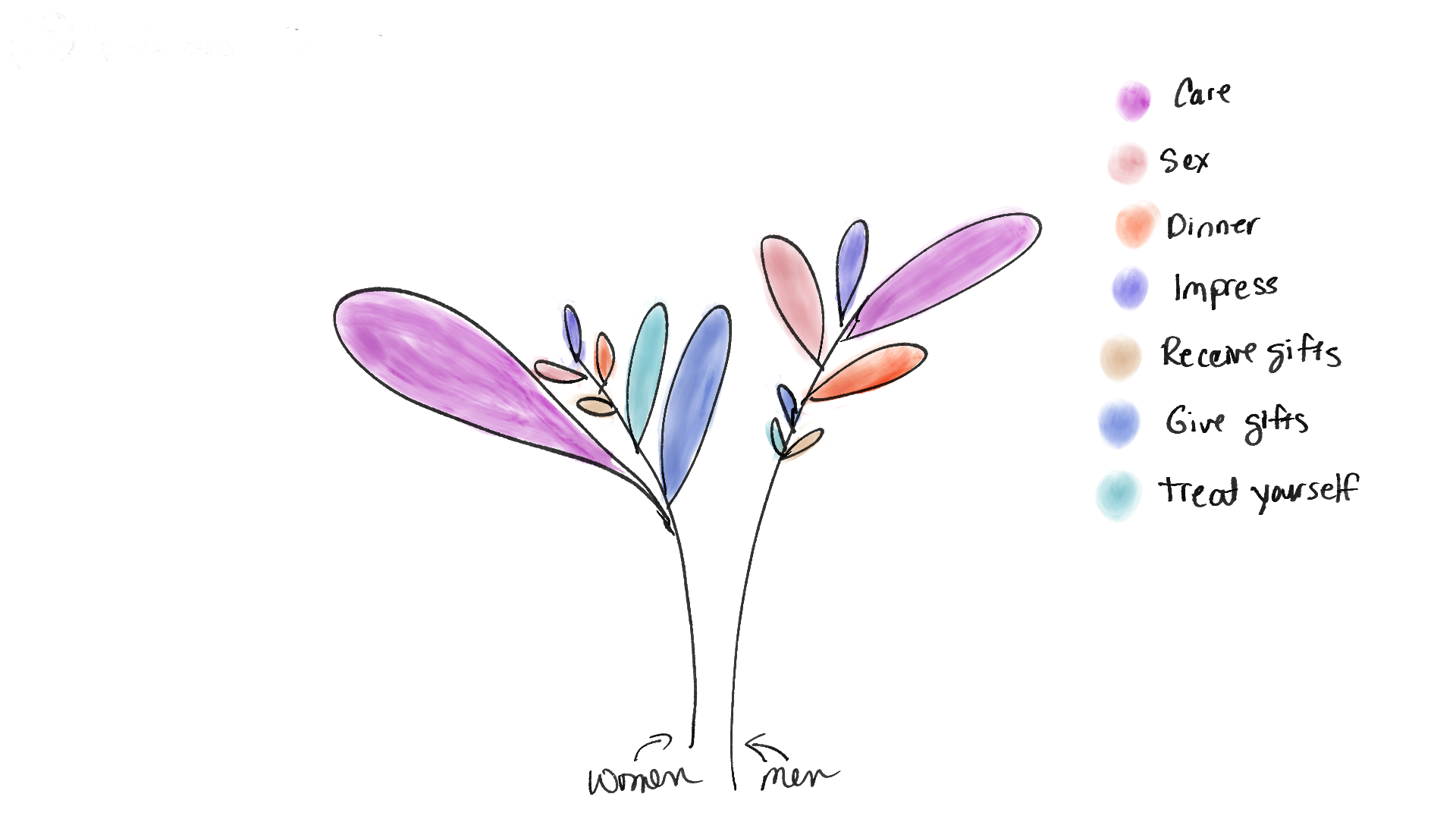
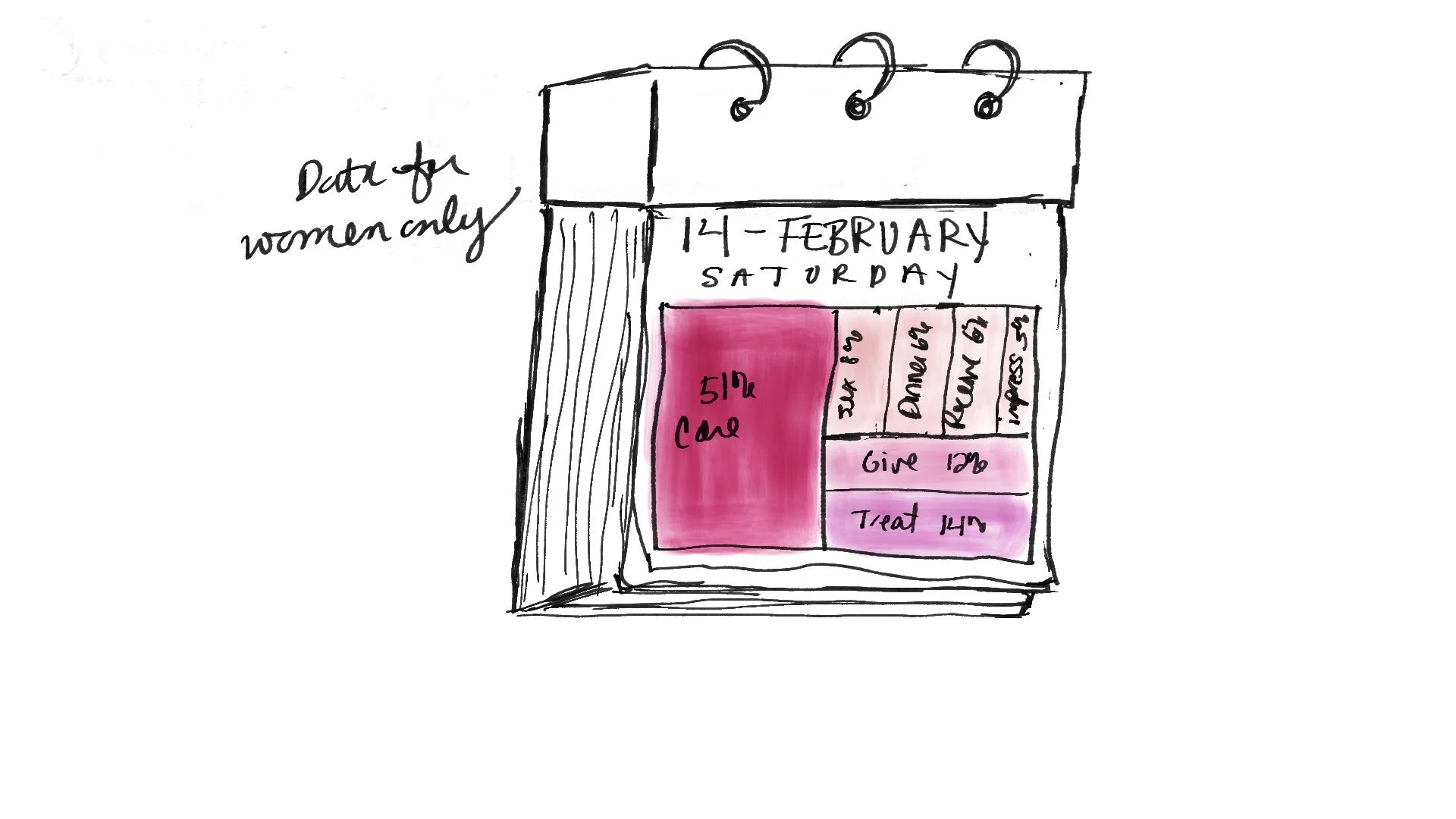
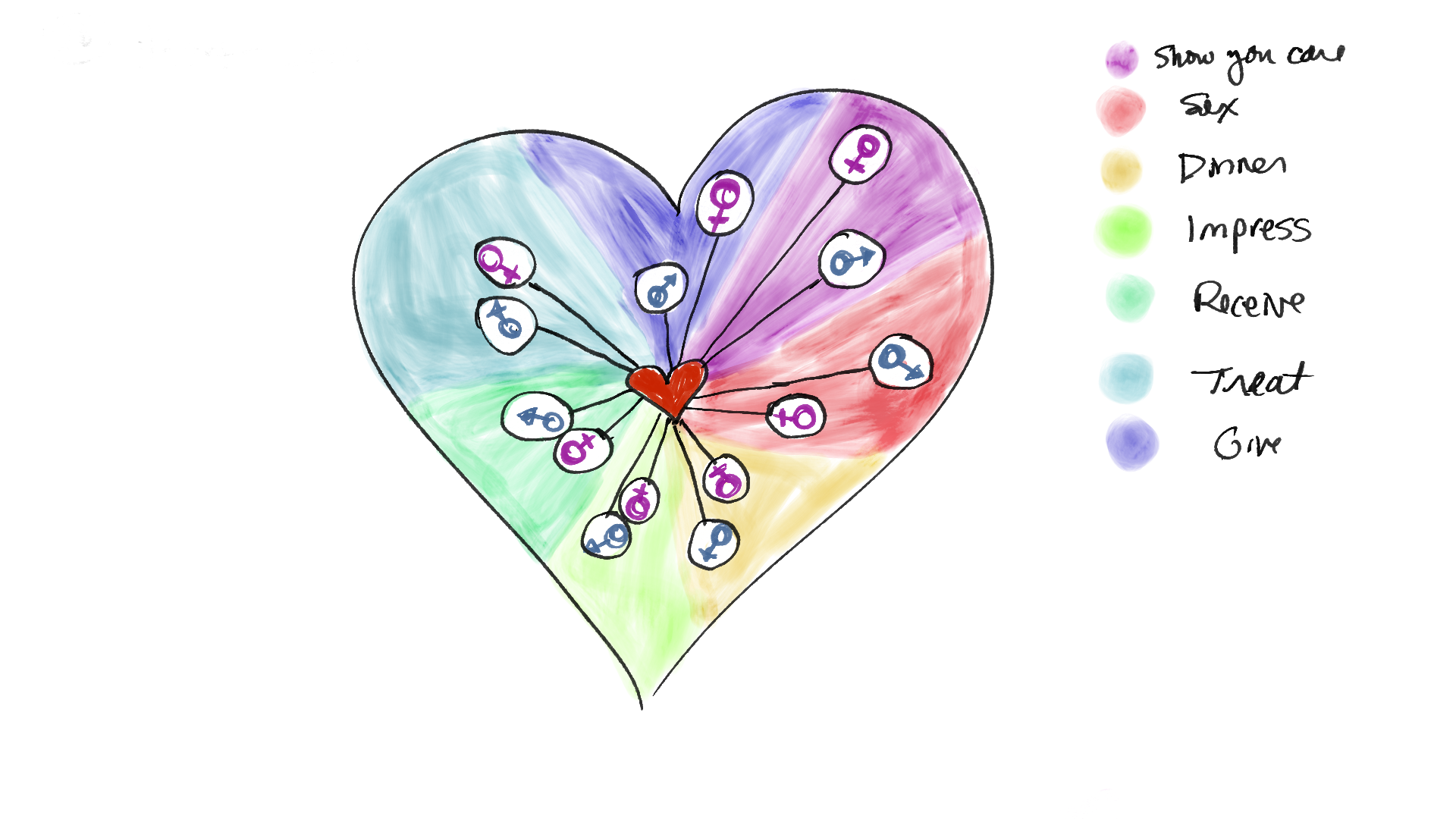
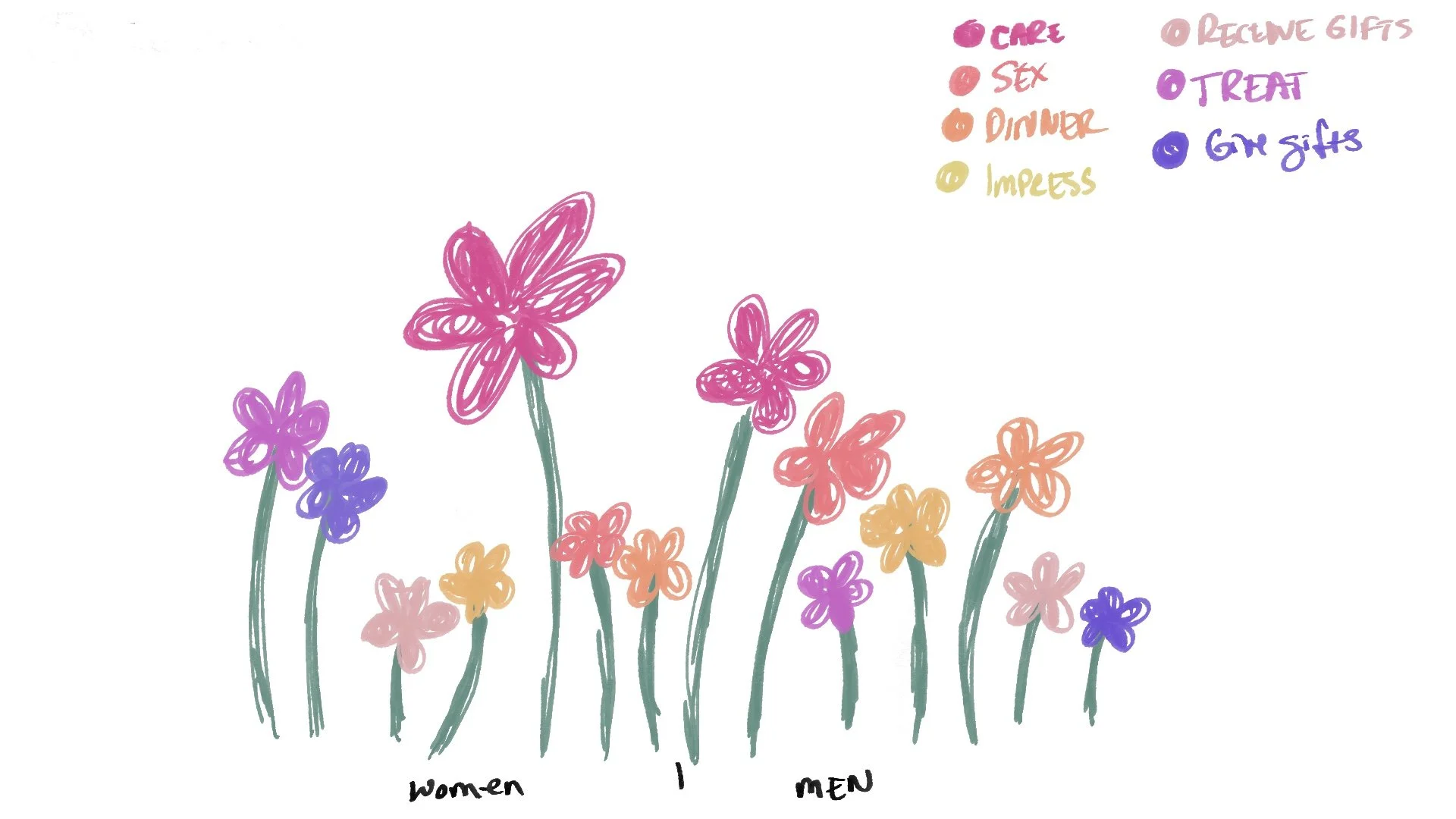
Sketches for my grad school class pulled from the following data source: What's the point in Valentine's Day? Divergent thinking ≠ chaos
Divergent thinking isn’t an exercise in throwing spaghetti at the wall and seeing what sticks. Instead, it’s structured excess. In sketching, you’re not looking for the idea. You’re looking for:
The obvious ideas (so you can get them out of the way)
The safe ideas (so you can acknowledge them)
The weird ideas (pay attention here, this is where the treasure often lies)
The uncomfortable idea (and definitely pay attention here since this is where we push the boundaries of what’s possible)
Those last two bullets may elicit responses like “well, that would never work, but…” and that “but” is often where the good stuff lives. You can take ideas from various bit and pieces, and put them together for new ideas. Sketching allows for broader collaboration across teams, it allows for sharing of ideas, for stealing like an artist, and getting the best of the best from a variety of perspectives.
Why sketching still matters
But seriously, where have all the sketches gone? Is it just me? Are we sketching less in product design than before? This is such a missed opportunity. Sketching forces you to stay in divergence longer than digital tools ever will (although, there’s some potential with AI, which I address later in this post).
The primary danger lies in jumping straight to Figma.
By going Figma first:
You start worrying about alignment instead of intent
You make decisions about hierarchy before you’ve explored alternatives
You polish ideas that have barely even been unearthed
You silo into screens instead of wholistic experiences
And at worst, you ship the wrong solution. No matter how right the pixels are, if they solve the wrong problem, it’s a failed design.
Figma is fantastic at making one idea look convincing, and that’s exactly the problem. And when a designer is staring down pixels, it’s harder to stop paying attention to margins and padding and interaction patterns. The mind simply shifts to that mode when in that tool, and no matter what the argument may be for ideating in Figma, it’s still much easier to get attached to a pixel perfect solution than it is a messy, imperfect sketch.
And therein lies the value…
Sketching, whether on paper, on an iPad, or on a whiteboard keeps ideas cheap, keeps them flowing, and makes them accessible and collaborative. They are disposable, mutable, malleable. You’re not invested or attached yet, and that’s the point.
Good ideation requires low commitment per idea and high volume overall.
Ideate first. Curate later.
Early ideation is not about quality. It’s about range.
Try to generate:
20-30 thumbnails, not 2 “strong concepts”
Variations that explore different metaphors, not just layouts
Ideas that solve the problem sideways, not just head-on
Only after you’ve exhausted the space do you switch modes, from divergent to convergent. That’s when you start asking:
Which ideas align to the problem, not just the solution?
Which ones scale?
Which ones surprise and make sense?
Workshops using Crazy 8’s or Six-ups with time boxing are also a good way to frame the exercise in a group setting where you start broad and slowly get more narrower and specific in each round.
But simply put: convergence without divergence is just an exercise in debating and recycling opinions in a pixel-shaped vacuum.
What about sketches, sketch sessions, and remote teams?
This is not a blocker. I've been running remote sketch sessions for more than a decade. Just use Miro, FigJam, Mural, or any other whiteboarding tool, and have your participants snap a photo and upload their pen and paper sketches there.
The discipline is resisting premature certainty
The hardest part of ideation isn’t coming up with ideas. It’s resisting the urge to fall in love too early. Certainty feels productive. Ideation feels messy. But if you skip the important phases of ideation, you risk landing on a solution that feels right, but often isn’t.
Great designers delay certainty on purpose. They stay curious longer than is comfortable. They explore past the point where most people would stop and say, “Yeah, that’s probably fine.”
This is all part of the craft of design, and in an AI-driven world, it also helps continue to set designers apart.
There’s also a psychological component
High-fidelity tools can increase cognitive load and create premature commitment. The more complete something looks, the harder it is to critique or discard. Sketches signal provisional thinking. They reduce attachment and sunk-cost fallacy. They free cognitive bandwidth for structural exploration.
Analog work also slows the brain just enough to surface alternative pathways. When you draw, you externalize thought incrementally. Partial ideas are allowed to exist. Digital tools often push toward completion. Divergence thrives in incompletion.
A simple rule of thumb
If your “ideation” phase ends with:
One tidy Figma frame
One concept you’ve already seen before
One idea you arrived at suspiciously fast
You may not have cycled through enough ideas.
Start with divergence. Sketch aggressively. Make bad ideas on purpose. Resist the Figma urge. It’s not slower. It’s how designs get better, and it saves costly mistakes later on.
So then…what about ideation with AI tools?
Yes, let’s talk about it because it’s the elephant in the room at the moment.
Tools like Lovable (and similar AI-assisted prototyping platforms) are powerful. They can take a rough idea and turn it into working code shockingly fast (although as an aside: the more complex your tool stack, the harder this is, and most only work with certain frameworks out of the box).
But here’s the danger: when early ideation looks too much like the real thing, the room shifts too early.
Instead of asking:
What problem are we actually solving?
What are the jobs to be done? Where is the user in their journey?
How does this connect to the rest of the ecosystem?
What are the alternative models?
What happens if we invert the premise?
We start asking:
Should this button be on the left?
Is this spacing correct?
Why is this state slightly off?
What’s going on with this microinteraction?
Why is this pattern not exactly as it is in the design system?
Pixels enter the conversation before the problem is fully explored. AI tools compress time. That’s their value. But they also can compress ambiguity. And ambiguity is where divergence lives.
If you move from idea to something that looks shippable in minutes, it creates premature gravity. The prototype feels real. Stakeholders anchor to it. Engineers react to implementation details. The conversation narrows.
That’s not an AI problem. That’s a sequencing problem.
Where AI does shine
Used intentionally, AI prototyping tools are fantastic for:
Rapid alignment between PM, Design, and Engineering
Testing feasibility early
Exploring interaction patterns quickly
Turning sketches into something clickable for validation
In that sense, they can function a lot like sketching if done correctly. They are shared artifacts that help teams think together. And you can even make your prototypes look like sketches or rough wires. There is no rule that says they must look finished, and depending on where you use AI in the process, this may be a preferred approach.
But they are still not a substitute for quick, divergent thinking and problem solving. Nothing replaces paper, pens and highlighters, a whiteboard (virtual or real), and permission to be wrong.
The Figma effect
Over the last decade, design has quietly been pushed toward production-ready deliverables. The output became the artifact. The artifact became the value.
And suddenly, designers were judged on pixel precision instead of problem framing. After years of fighting for a seat at the strategy table, our own tools have kicked us back.
When ideation starts in Figma, or now more recently, in a high-fidelity AI-generated prototype, we reinforce that pattern. We optimize too early. We polish too soon. We collapse exploration into execution.
Sketching disrupts that.
It pulls design back upstream. It centers thinking over rendering. It repositions the designer as a systems thinker and creative idea generator, not a pixel pusher.
AI tools are accelerants, and that’s incredibly useful. But acceleration without divergence just gets you to the wrong place faster.
AI has the potential to disrupt our design processes, but maybe not entirely in the way we think. This may be just another way to get back to the problem-solving basics and get us away from the current pixel obsession too early in the process.
So no matter where you choose to ideate: Sketch first. Diverge deliberately. Generate weird ideas on purpose.
As designers, let’s leverage this industry-shifting moment to reset our design processes instead of just bolting AI onto them. Let’s rethink what’s working (and what’s not), reframe how we get things done, and maybe even get back to some of the basics that designers do best.
Read more of my thinking on design process, going analog, and AI:
Rage against the machine: the new analog movement
Has AI changed the quality bar for design?